When I went vegan one of the things that overwhelmed me, more than reading food labels, was figuring out which animal-free and all-natural body products and cleaning products to buy. After all, the labels on foods are pretty easy to decipher. For example, look at these peanut butter ingredients:
Peanuts, salt.
Compare that with the ingredients in a Twinkie:
Enriched wheat flour, sugar, corn syrup, niacin, water, high fructose corn syrup, vegetable and/or animal shortening – containing one or more of partially hydrogenated soybean, cottonseed and canola oil, beef fat, dextrose, whole eggs, modified corn starch, cellulose gum, whey, leavenings, salt, cornstarch, corn flour, corn syrup, solids, mono and diglycerides, soy lecithin, polysorbate 60, dextrin, calcium caseinate, sodium stearoyl lactylate, wheat gluten, calcium sulphate, natural and artificial flavors, caramel color, yellow #5, red dye #40.
Clearly, there are several non-vegan ingredients, but even from a distance I could have already put the package down based on the crazy long list of ingredients and a virtual who’s who of pseudo-foods I have no interest in eating. (As an aside here, beef fat? Who in the creation of a cake has ever said, “You know what this yellow cake needs? A bit of beef fat!”)
So the food part was easy, especially if one sticks to the section of the grocery store where labels aren’t needed – the produce section. However, when it came to body products and cleaning products, the process was trickier. After all, just because I might not be familiar with the term “lauryl polyglucose,” which is an ingredient in glass cleaner, doesn’t mean that it’s necessarily bad. What is it and is it plant-based? And what about animal testing? The companies that don’t test on animals often put a jumping bunny logo on their products with the words “Not tested on animals, no animal ingredients.” However, not every company does that, and where to start?
Finally, even after purchasing the product there was a trial period, because not every product works as well as one might hope. It takes time to find products that live up to the task, while remaining in alignment with my values of compassion and desire to use products that are healthful. I remember wishing at the time that there was a list of animal-friendly and natural products I could refer to and just buy those, at least as a starting point. With that in mind, I’m planning on writing about the various cleaners and body products that I make or buy in the coming weeks. (I’ve already written about one of my favorite cosmetics and body care brands, 100% Pure.)
Today, I’m starting with the first thing that goes on after a shower – deodorant. Like many of us, when I started using it as a pre-teen, I just used what my mom brought home, which was the brand she’d been using since she was a pre-teen. As an adult, I based my choices around the ad campaigns that I liked. (Very discriminating standards, as you can tell…) Now that I was coming at it from a health perspective (both of my health and the health of bunnies, guinea pigs, and mice, on whom many body products are tested), I was looking at it through a different lens. Now I needed a product without animal ingredients, animal testing, aluminum, parabens, petrochemicals, phthalates, and propylene glycol. This also meant I’d be moving from antiperspirant to deodorant. I didn’t relish the thought, honestly. I liked feeling dry all day. And pit stains? Not cute. Still, I was up for the challenge.
I tried brand after brand of natural deodorants on the shelves of my natural food store. The results? Not pretty. Finally, I heard about a brand called Lavanila. It’s a natural deodorant sold at Sephora and it got rave reviews. The ingredient list, which starts with aloe juice, looked good. They don’t use ingredients that were tested on animals, and the final product is not tested on animals. There was only one small problem – the cost. While I was used to spending a few dollars on my deodorant, Lavanila costs $18. This seemed ridiculously steep for something I was just going to rub on my armpits everyday. But I bit the bullet, paid the 18 bucks, and gloriously, it worked. At the end of the day, I was still smelling fresh and clean. (It didn’t keep me dry, but it’s a deodorant, not an antiperspirant.)
As I was nearing the end of my roll, a friend mentioned to me that she makes her own deodorant using coconut oil, corn starch or arrowroot powder, and baking soda. I was intrigued but unsure. Would it work? Did I want to make something else in my life from scratch? Still, my friend said she’d been doing it for a year with great results and that one batch lasts a long time. I had all of the ingredients in my kitchen already, and so one afternoon I took the leap.
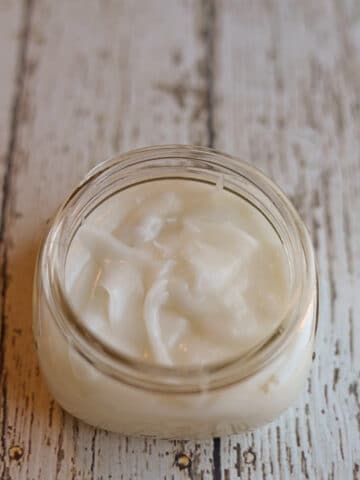
I mixed the coconut oil, corn starch, and baking soda in a bowl. The coconut oil mixes easier when it’s a warm liquid as opposed to a cool solid. (If it’s too hard to mix easily, use your fingers, and the warmth of your hands will liquefy it, making it easier to use.) I moved the deodorant into a jar, and then I took a small amount onto my fingers and rubbed it into my underarm area. I’ve been using it for the past couple of months, and I’m hooked. Not only does it keep me smelling sweet, I find it keeps me pretty dry as well, even when biking in the summer heat.
Even without taking the cost into consideration, I like it better than the $18 Lavanila. It just involves mixing three ingredients, and I keep it in the cupboard of my bathroom. Since coconut oil is a liquid in heat and a solid when cool, the consistency varies upon temperature but it works equally well regardless. I haven’t had any problem with the oils staining my clothes.
I’ve noticed there are a million and one variations on this recipe all over the web, but I believe this version from Passionate Homemaking is the original. Some people use more or less of the ingredients, some people just use coconut oil alone, and some include things like essential oils for fragrance. Personally, I like the coconutty, tropical smell as-is. I’ve read some people complain that the baking soda and/or corn starch gives them a rash in certain quantities, and so if you find that, increase the coconut oil. I have sensitive skin, and I haven’t had any problem with it.
Coconut Oil Deodorant
1/4 cup aluminum-free baking soda
1/4 cup cornstarch or arrowroot powder
5-6 Tablespoons coconut oil
Mix in a bowl until fully combined and creamy. Move to a jar with lid or other container.
For more information on animal testing, check out this link from Mercy for Animals or listen to this podcast from Vegetarian Food for Thought. To find companies that do & don’t test on animals with printable files that you can bring with you to the store, click here.
Disclaimer: All products mentioned in this post were purchased by me and the opinions are totally my own.