


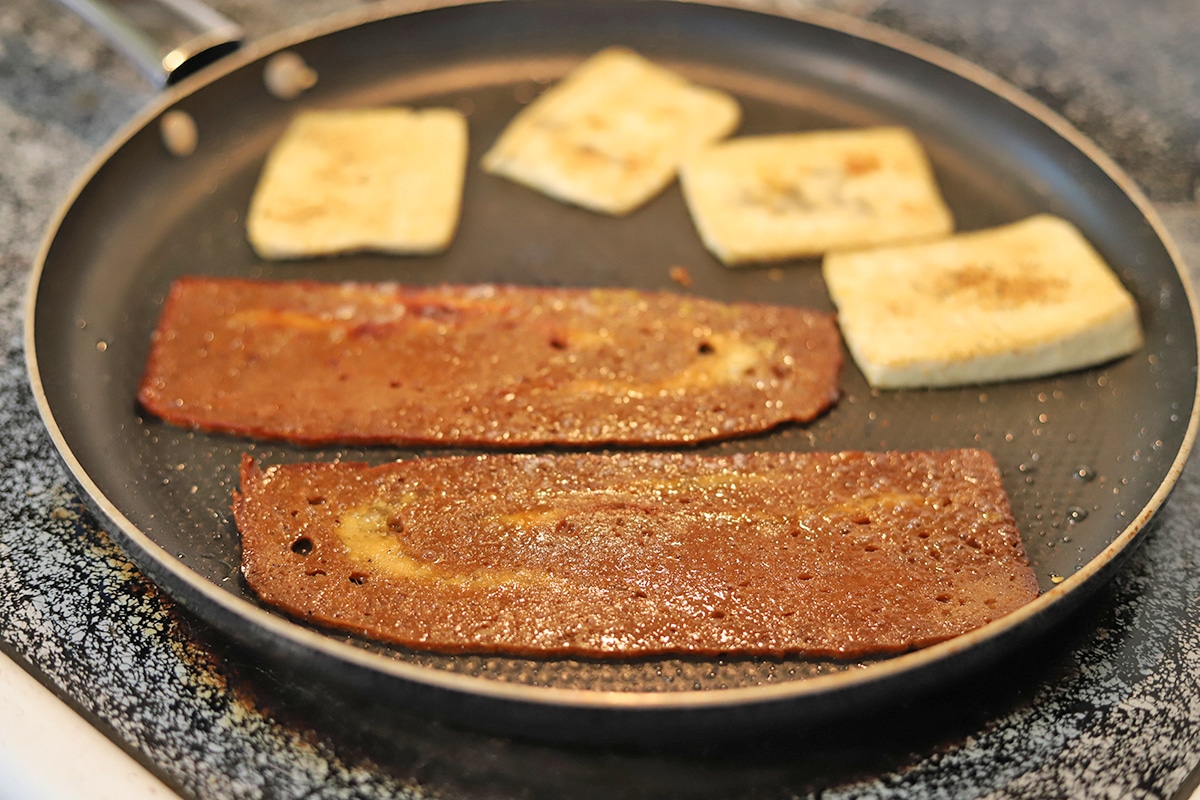
If you want to get an immediate conversation going on your Facebook page, post a picture of bacon made from tofu or seitan (wheat meat). About this topic, it seems almost everyone has an opinion.
"If you really want to eat bacon, then eat the real thing."
"That's so unnatural!"
“Vegan meat is an oxymoron.”
Whether it's a company posting their new chicken-style cutlets made of wheat or restaurants showing off their acclaimed vegan reubens, you can practically count down in the comments section to the people whose ire is raised by the mere mention of plant based meats, milk, and cheeses. 3, 2, 1…
"Why not just eat fruits and vegetables?"
For my next few posts in this ongoing series on vegan misconceptions, I'm going to clarify my own thoughts on vegan meat, cheese, and milk. The obvious place to start is here:
Why do vegans eat things that taste like meat?

While there are some people who stop eating animals and their secretions because they don't like the flavor, taste, or texture, that wasn't my reason. In fact, most of the vegans and vegetarians I know grew up eating animal products.
I stopped eating animals, because I didn't want to take part in the suffering of others when I had the choice to do otherwise.
I'd always considered myself an animal lover. But I realized that I was stopping that compassion for animals when it came to those animals who I ate instead of cuddled.
Why not eat “humane meat” instead?
For a period before I went vegetarian, I ate what is dubbed "humane meat."
Then I realized three things. Humane meat is a marketing term that is unregulated. There is no such thing as pain-free slaughter. And the common link in all animals is that we want to live and care for our off-spring.
So I had to say goodbye to animal-based meat, cheese, milk, and eggs.
Regarding "humane meat,” even if such a thing were possible, I also had to get honest with myself that it wasn't something I was consistent about all of the time.
That's what I was buying for my refrigerator at home. But when I ate out multiple times a week, that wasn't what was served at most of the restaurants I was visiting.
If it mattered, then it needed to matter everywhere, not just where it was convenient.
So when I transitioned to a plant-based diet, I did it because I didn't want to pay someone to kill animals on my behalf. And that's what I was doing when I was going to the grocery store and buying slabs of meat wrapped in plastic.
But why buy vegan meat? Why not just eat fruits and vegetables?

When I first went vegetarian, I was used to and familiar with animal-based foods. That's what I'd grown up eating. And like many people, those are the foods to which I had attachments.
Going vegan meant that I learned about a lot of new foods I'd never tried before and meant that I was eating more produce than I ever had.
However, there were still times that I wanted to have some old favorites, or that I had specific desires for something salty, smoky, or chewy.
Having a breaded and fried piece of seitan or a smoky tempeh BLT was a way to satisfy the desire for those flavors without compromising on my values of compassion.
While I do have an ethical issue with meat, dairy, and eggs, I don't have an ethical issue with grilled flavors, smoky flavors, chewy textures, or creamy textures.

I also discovered that a lot of what I was craving had to do with the delivery system more than the meat itself.
I liked the breading, horseradish, mustard, or pickles on my sandwiches. I liked the ketchup, barbecue sauce, or cocktail sauce.
Many times the part of the experience I enjoyed the most was plant based. So it was easy to just swap out the animal-portion of the meal for something else.
Also interesting, when I went vegetarian it was the first time that I really started cooking in earnest.
I was thirty by that point. So of course, I had technically cooked plenty of things. But up until then taco seasoning came from packets and curry sauce came from jars.

Going vegan meant that I started really learning about spices and cooking methods. And I made some interesting discoveries.
First, the real flavor in tacos is cumin, chili powder, and paprika. When it comes down to it, while the meat gave a particular texture, the dominant flavors were of the plant-based spices.
And the first time I made breakfast sausages with tempeh, I realized that sausage flavor was fennel seed more than anything else.
And it makes sense. Look at pork chops, bacon, and ham. They all come off the same animal, but they taste different based on the ways they've been flavored and cured.

Let's take the ubiquitous bacon. It doesn't come off of a pig's belly tasting the same as it does on the Tremendous Twelve at Perkins.
After the flesh is removed from the animal, it's cured with brown sugar and salt. It's left uncovered until it forms a pellicle, which according to a bacon-making website is "a tacky, gooey layer that forms on the outside of the meat after curing." Finally, it's smoked with applewood, hickory, or mesquite.
People act like the meat version is natural and untouched while the plant-based version is fake, but both involve a process of seasoning. Personally, I'd rather have mine without the layer of pellicle.
If I want to add sugar, salt, and smoke to something like tempeh, mushrooms, or coconut flakes, I don't feel like the animal industry owns that concept.
(The seitan bacon pictured above was made by Herbivorous Butcher, a vegan meat maker in Minnesota. At the top of this post, the seitan bacon was made by Upton’s Naturals in Chicago.)
Additionally, vegan meat has the added benefit in terms of what it's missing - saturated fat and cholesterol, of course, but also gristle in burgers, blood pooling at the bottom of the plate, and tendons in chickens' legs.
I used to get grossed out when blood would come out of a chicken's thigh as I fried it. There's none of that in a vegan fried chicken drumstick.

I would wager that most people outside of internet trolls and contrarians would feel more comfortable with lunch afterwards if their trip to the sausage factory involved watching fields of wheat getting processed into flour and then made into dough by my own two hands.
As opposed to riding away from a farm in a metal truck with a group of pigs, seeing them stunned and slit, cut into parts, put through a grinder, spices added, and then tossed into a frying pan.
Like most vegans that I know, I didn't go vegan because I didn't like the texture or taste of animal-based meat.
I went vegan because I didn't want to contribute to violence and suffering. I went vegan because I think there's a higher ethic than, "It tastes good."
To continue with this series, in the next post I address this complaint regarding plant-based meat and non-dairy milk: “Vegans should come up with their own names for things. Their plant-based versions are not real.”



Priya Bansal
I came onto your site looking for why, exactly, humans love meat so much, and you’ve given me a lot of insight. So here’s my story:
I’ve been vegetarian since I was born (I’m Hindu), and went vegan a few months ago. I’ve never had a desire to eat meat since I never grew up eating meat. I have had meat accidentally before, but most of the times I hated the taste of it. The first time I ate pepperoni my stomach hurt for a day, and the second time didn’t feel too good either. The one time I wasn’t completely disgusted by a piece of meat was when I was eating it in the form of pizza rolls (my neighbor didn’t bother to tell me there was meat in it until I was almost done with them), but it wasn’t any better than a lot of plant-based foods I’ve eaten, and I realized I liked it only because of the spices that were in it. When I turned vegan I did have occasional cravings for dairy and egg products, so I bought vegan versions of them. However, like you, I’ve realized that the things I liked about these products were how they were made, not what they were made of, so I was able to find many raw substitutes (ex shredded potato instead of cheese on my “cheese” noodles). It’s no wonder why we’re able to mimic the taste of “meat” so well.
Now to wait for the day when our children will say, “did they really used to eat animals 100 years ago?!”
Karley
If your soy product does not specifically indicate that it is GMO-free, then there is 90% chance that is made from Monsanto’s Round-Up Ready soy, as they have a monopoly on the soy market (that is, unless you’re buying your soy directly from a farmer who uses non-GMO seed). The monocropping and cultivation practices used to produce soy require the intensive use of petrochemicals and toxic pesticides and herbicides. These chemicals end up in groundwater and wreak devastation on the ecosystem, from insects to amphibians and birds. The tractors, combines, and other machinery used to cultivate the soy kill birds and small mammals in the fields—to make no mention of the utter annihilation of insects–crop pests, honey bees, and butterflies included.
A vegan diet heavy in TSPs absolutely does NOT eliminate the suffering or death of animals. It’s just that birds, bugs, and voles are far less charismatic than the big brown eyes of a cow and left out of the conversation, as the average person has absolutely no idea how the raw products that go into their food are actually produced.
What a vegan diet heavy is TSP does accomplish is helping one of the most immoral and unscrupulous companies in the history of the planet continue to turn profits at the expense of biodiversity and human, animal, and planetary health.
Supporting local farmers who use more environmentally-benign cultivation practices and buying seasonal produce are constructive, community-building actions you can take to minimize the amount of animal suffering perpetuated by your dollars.
Cadry
Hi, Karley,
Thanks for your input! I couldn’t agree with you more about Monsanto. The impact that they’ve made on our food supply and world is mortifying. My experience has been that concern about social issues (and our food supply being one of them) does not exist in a vacuum. As people learn more about the true costs of their food and that cheap food has a high price, they make changes accordingly. Most vegans I know stay far away from GMO’s, paying special attention to buying organically and locally, visiting their farmers markets, and joining CSA’s. Personally, I’m a member of a local Co-op, and I visit my farmers market twice a week, where I have relationships with several of my local farmers. At my Co-op, they don’t even sell GMO tofu. (And luckily, nowadays organic tofu can even be found at very mainstream places like Target.) It’s becoming easier and easier to vote with your dollars, and I do. Hopefully with time more labeling laws will come into effect making the avoidance of GMO’s easier.
I live in Iowa, and I’m surrounded by fields of soy and corn. This abundance of crops, however, is not going to make veggie dogs. It’s going to be fed to animals, who will later be slaughtered. So that’s why I think it’s important for everyone to be concerned about GMO’s, whether they are vegan or not. Because the reason that Monsanto has become so hugely problematic is because people have come to expect cheap meat, dairy, and eggs, not because vegans, who make up less than 5% of the population, are buying veggie burgers. Cheap meat is created, in part, by having cheap feed like GMO and pesticide laden soy and corn. Besides, it takes 16 pounds of grain to make 1 pound of beef. So it takes that much more corn & soybeans to make a hamburger than it would a veggie burger or helping of edamame.
For me the birds, bugs, and voles that you mentioned are very much part of the conversation. I do what I can first, by supporting organic practices and small farms, and second, by being vegan. Ten billion animals are killed in the U.S. alone every year for human consumption. That number goes to 45 billion when sea life is included. Three million wild animals (including prairie dogs, wild horses, and donkeys) are then killed to protect grazing livestock animals. About 70% of the grain grown in the U.S. is fed to animals. That means that when that grain is harvested, that many more small animals/bugs are killed in the processing than if people were just eating the grains directly and not feeding it to animals instead, who will later be slaughtered. Finally, with the excess of manure and urine of raising vast amounts of animals, the waterways become polluted, killing birds and fish. Eating a diet that includes the consumption of meat means far more suffering than the consumption of only plants.
Sadly, “local” farms in Iowa means factory farms too, of which there are many. I support small farmers and try to make the best decisions that I can where animals and the environment are concerned.
Herbivore Triathlete
I agree with this entire post. It is well written and informative. I think you handled a controversial topic in a fantastic way. I found your blog via Keepin’ It Kind and am happy I did.
Cadry
Thanks, HT! I’m glad that you found me. Kristy’s blog is so wonderful and one of my favorites in the blogosphere! 🙂
acookinthemaking
I love this post and I want to share it with all of the people in my life (and there are many) who criticize my diet as “unnatural” and refer to my foods as the “fake” version of cheese, bacon, chicken, fill-in-the-blank…
My favorite line: “If I want to add sugar, salt, and smoke to something like tempeh, mushrooms, or coconut flakes, I don’t feel like the animal industry owns that concept.” AMEN.
Thank you so much for this post!
Cadry
You’re welcome! Thank you for letting me know that it resonated with you!
Shauna
I am so glad I found your blog! I live in West Des Moines, so your reviews of places I know are great. I also feel like I really relate to you and your experiences, especially in regards to this post. Hooray!
Cadry
Hi, Shauna! Thanks for stopping by! I’m glad to hear that you’ve enjoyed this post and my posts about Des Moines area restaurants. The DSM reviews don’t get the same amount of comments as other posts, and so I wondered if anyone was reading them. I’m glad to know that you’re out there! 🙂
I grew up in Des Moines and have been so impressed at the way more and more vegan options are popping up. The last time that I was there, I visited the area Whole Foods and saw that they have vegan chocolate cake from Chicago Diner in their bakery area. Very cool!
Barb@ThatWasVegan?
I don’t think I’ve ever met a vegan or vegetarian who made the change because they didn’t like the taste of meat or cheese. I certainly didn’t. And while I try not to eat too many of the processed faux products, I fully admit to loving them and THERE’S NOTHING WRONG WITH THAT, DAMMIT!
🙂
Cadry
Preach it, Barb! 😉
missy211
Bless this post.
Cadry
Thank you, Missy!
Mike Bird
This brought memories of when I turned vegetarian some 57 years ago and some of the discussions I had with parents and friends. Easy with beef – I hate the taste, but bacon smells so good that I” certainly take the fake as the only way to experience that taste. Wasn’t so easy back then as there wasn’t the variety of produce available and some tasted like cardboard!!
So why haven’t I made the transition to vegan? Not really sure, perhaps because it was too hard as there were no alternative to leather shoes. Mainly because I find it hard to give up cheese. Morality takes a step backwards. But there was mention of non-dairy cheese in the comments so I’ll see if that is available in the UK. Also Tofurky.
Thanks for the site and for the recipes I’ll be trying out.
Robin
I love this series! The comments are great, too!
Cadry
I’m glad to hear that, Robin! I too am loving reading everyone’s feedback and insights!
Joey
I’m going to get your last paragraph printed on a T-shirt and any time anyone makes a daft argument about veganism, I’ll just point at my T-shirt and smile.
Cadry
Ha! I’d love to be a little mouse taking in that interaction! 😉
Sophie
I think it’s an odd “argument” to begin with. I don’t think too many people go vegan simply because they dislike the taste of all animal products! I enjoy bacon flavor and the texture of cheese. It doesn’t mean I want to eat the real thing but I will settle for a kinder version!
Cadry
So true, Sophie!
Somer
Loving this series so much Cadry, you echoed my thoughts exactly this week. I linked to this post in my post today, I hope you don’t mind. xx
Cadry
Thank you, Somer! And thanks for sharing this post too! 🙂
Maggie Muggins
Fantastic post! I have never (in real life) had someone ask me why I’m eating the “fake” thing when I can just have the real thing, but I’ve seen it numerous times online. It seems like such a ridiculous question to me since you’re making a huge assumption about the reasons we all went veg in the first place. Not everyone in the world goes veg for health reasons or because they hate the taste! Sigh.
Like you said, I get a kick out of how people think the chicken, bacon, etc. they eat is “natural” and our version is “fake”, everything goes through processing and has salt solutions, flavourings, preservatives and what not added to it and in my opinion, my smoky, mapley, salty delicious tofu bacon is as real as it gets 🙂
Cadry
Well said, Maggie! I’d love a few forkfuls of your very real tofu bacon!
Natasha
What a great post! The next time I get harassed for bringing fake meat to a cookout, I’ll point them to this post. What annoys me the most is when people tell me that fake meat is “sooo processed.” Um, do you not think that real meat is processed?
Cadry
Yes, and I’d add too that many of these options aren’t that processed anyway. When it comes to homemade bean burgers, seitan, tofu, or tempeh, they’re not that far off from their original states.
GiRRL_Earth
Beautifully written! Wow! This post should be on every billboard in America.
Cadry
Thanks so much! I think we’re going to need bigger billboards! 😉
Anonymous
Fantastic post and I totally agree with the sentiment. I don’t really eat the ‘fake’ meats/cheeses but when you go to a friend’s house, they often try to prepare a special meal for me by including something like a “chicken schnitzel”, and then I eat it.
I think the “fake” food is very important for people that are transitioning to a plant-based diet. You can continue eating the foods you know, but just skip on the cruelty. If that is what it takes for people to transition to eating plants, hey, fine by me.
I agree, it is all the flavours that we know and enjoy, once you have the knack of integrating it into whole-foods plant-based dishes, food is a lot more interesting and enjoyable.
Cadry
Good points about plant-based meats and cheeses being good transition foods. When people are used to certain textures and flavors, it can be easier to move into a vegan diet if there are familiar stand-ins.
Richa
Another great post Cadry.. There were months in between when I hadnt figured it out in my head yet about eating things which taste like animal based things.
And it is so true, there is always one person who will talk about eating the real deal.
thank you for this well written series.
Cadry
Thanks, Richa! I’m glad that it’s resonating with you.
BK
Perfectly composed… amen!
Cadry
Thank you, BK!
An Unrefined Vegan
Yes! That’s it exactly – – it’s the FLAVOR we respond to and crave – not the meat!
Cadry
Absolutely!
Bobbie {the vegan crew}
“While I do have an ethical issue with meat, dairy, and eggs, I don’t have an ethical issue with grilled flavors, smoky flavors, chewy textures, or creamy textures.” Exactly! For the vast majority, taste isn’t the issue at all; it’s that they don’t want to contribute to the unnecessary and inherent suffering. Lovely post…
Cadry
Thanks, Bobbie!
Mel
Great post Cadry, I have many more of yours to catch up on…
“People act like the meat version is natural and untouched while the plant-based version is fake, but both involve a process of seasoning.”
That’s so true and I’ve experienced that sort of reaction from people before. Meat eaters can get so defensive without even stopping for a moment to question what they are in fact eating and the process behind it. Most vegans seem to be way more aware of what they are putting in their bodies that the general population.
Cadry
Yes, it’s so easy to fall into the idea that our habits are neutral and not give them a second thought.
It’s nice to see you back, Mel!
Sandy
Love this, very well said.
Cadry
Thank you, Sandy! So nice to hear!
Andrea
“Animals and their secretions,” yup, unhuh — that’s exactly the way I describe animal food. Another great post and one that everyone should read because it treats the subject in such a clear, visual and realistic way. You really captured the cultural as well as the flavor-and texture-based reasons why meat analogs and other subs (like coconut whipped cream or non-dairy cheese) are so popular. I am comfortable with traditional foods like tofu, tempeh and seitan, and even some newer meat-like things like sausage. I haven’t ever bought the newest ones like Gardein and similar very realistic meat analogs. Partly it’s because I don’t like the ingredients, but I sure can understand and appreciate their appeal.
I remember an omnivore friend declaring her disgust at vegan/vegetarians who tried to make their food into shapes like burgers instead of just eating beans and rice and veggies. This was long before commercial products were easily available. At first, I felt embarrassed and ashamed for all the bean-burgers I’d made, but then I had a change of heart and asked, Why do meat-eaters make their food into burgers and loaves? Why not just eat the meat in a slab on a plate? A burger is just a shape, I told her, that fits handily into a bun. Why shouldn’t vegans/vegetarians be able to shape their food like omnivores can? She had no answer, but looked angry and confused. Sometimes I think some omnivores are just angry that we are shaking things up and causing others to question their ideas about food. As you said so well, “I would wager that most people outside of internet trolls and contrarians would feel more comfortable with lunch afterwards if their trip to the sausage factory involved watching fields of wheat getting processed into flour and then made into dough by my own two hands than they would riding away from a farm in a metal truck with a group of pigs, seeing them stunned and slit, cut into parts, put through a grinder, spices added, and then tossed into a frying pan.”
Cadry
I agree that there are certainly degrees in how processed or not certain vegan specialty products are. I’ve had Gardein before, but I can understand why the hexane aspect is a turn-off for people. Where seitan is concerned, I prefer homemade or Field Roast as a second choice.
You made so many good points, Andrea! I like how said that a burger is just a shape. I’m glad that you had that epiphany while your friend was still there, so that you could share that with her. Otherwise, that moment of you feeling embarrassed for no reason could have been something you stewed over later. For my next part of the series I was planning on talking about the defensiveness and anger that some people seem to have about vegans eating plant-based meats. I’m going to keep your example in mind!
Laloofah
P.S. I meant to say that I think this line especially struck a chord with me:
“While I do have an ethical issue with meat, dairy, and eggs, I don’t have an ethical issue with grilled flavors, smoky flavors, chewy textures, creamy textures, or gooey textures.” 🙂 Well said!
poppyday3000
For sure! When i really thought about what I ate, I was really more fond of “breaded and fried” than actual meat.
Laloofah
Another fantastic post that takes many of my disjointed thoughts and half-formed ideas and assembles them so beautifully into an eloquent and fluid essay. I agree with my fellow commentators about how very clearly you state things that so many of us think or experience, and how well you illuminate them for those who may not have seen them that way before.
I especially enjoyed the concept of meat as a “delivery system” for the flavors it’s been, well, flavored with! We had a vegan mind-meld on that topic: check out the comment I left yesterday on this pin! 🙂
For the first couple of years after we went from omnivore to vegan, we relied quite a bit on plant-based substitutes for our favorite and familiar foods. Like you, though, becoming vegan expanded our culinary horizons a great deal, and we haven’t felt a “need” for those for some time, and eat far fewer of them now. But that doesn’t mean we don’t still enjoy the chewy/crispy textures of Tofurky Italian sausage on our pizza, your delicious lemony baked rosemary tofu as a snack, or a few smoky tempeh strips on our TLTs!
Cadry
Thank you, Laloofah! A mind-meld indeed! If only Spock were a real person instead of a fictitious vegan character, he’d be so proud of us! 😉
I know what you mean about moving away from plant-based meats after the first couple years of vegetarianism. David and I were talking the other day about the “gifts” we’d give ourselves if we could somehow go back in time to when we were newly vegetarian. I would have taught myself how to make seitan much earlier. In those days I’d rely on Morningstar riblets when I was in the mood for something smoky & chewy, but homemade seitan is so much better!
Jackie at Vegan Yack Attack
What a terrific post! I didn’t know all that about bacon, and that makes it even more gross, in my mind.
While I originally went vegan for health and environmental reasons, very soon after I thought about animal rights, compassion and speciesism. I just love how you said that you don’t have a problem with textures and flavors, because really that’s what (vegan) food is all about.
I can’t wait to see more posts in this series! 🙂
Cadry
Thank you, Jackie! I completely concur about the grossness. As I was reading the description of how to make bacon on that website I wondered if it sounded equally nauseating to the people who were planning on making it.
I think a lot of people have the experience that you did, in which they go vegan for health or environmental reasons, and then once they are no longer eating animals, they have an easier time being open to learning about the compassionate aspects. I think even unknowingly we can have a certain amount of defensiveness that keeps us from looking at videos or learning more information, because we don’t want to feel guilty. Once we’re no longer taking part in the animal industry, it’s easier to gather that information and be open to it.
Umapuma
Yup, I miss pork green chile, summertime burgers and cheese pizza but I feel alot happier not eating those things because I want to help. Hooray for Tofurkey frozen pizzas and so many other wonderful options that do help animals!
Cadry
Good for you, Umapuma! I haven’t tried the Tofurky frozen pizzas yet. Do you recommend them?
Katie Al Stewart
Well said!!
Cadry
Thank you, Katie! And thanks for stopping by!
Kristy
Yes! I’ve always had a hard time articulating my thoughts on this subject. I love this line: ” I don’t feel like the animal industry owns that concept.” It is all about the seasoning. Just as one wouldn’t take a bite of freshly killed pig, one wouldn’t take a bite out of unprepared, unseasoned tempeh (or if they did, they likely would not enjoy it!). Well said, my friend. Well said. 🙂
Cadry
Absolutely! So much about what makes food taste good comes down to seasoning and preparations.
Abby
I love everything about this post, mostly because I think we have so much in common in terms of how we’ve arrived where we are (although I am far behind you as a constant work in progress.) My story reads so similar except I’ve been a vegetarian for 9 years but only vegan for about 6 months (held onto my eggs until the end…) I never was really that into meat and only ate it because that’s what we did. When I dropped it, I never missed it because a) the thought repulsed me at that point but b) I learned about seasonings (the fact I covered my mom’s meatload in ketchup b/c I didn’t like the taste should’ve been a sign.) That’s why I never took to “fake” meat products–some are too close to tasting too similar for me.
Anyway, I’m rambling. But I think this post is a great example of how many people simply assume that what they’ve done is what they’ve always had to do. With a little exploration and elbow grease, you can discover a more creative and compassionate way to eat.
Abby
Ugh. “Meatloaf” and not “meatload.” Eww.
Cadry
Thank you for sharing your story, Abby! I love hearing how people got to where they are today. I can totally understand how for a person who was never interested in meat anyway, foods that emulate the same textures or flavors wouldn’t hold any draw.
I really liked what you had to say in the last paragraph about how just because we’ve done something in the past doesn’t mean we have to continue in the future. Just because our families might have eaten a particular food or behaved in a particular way doesn’t mean that we are under some obligation to continue.